
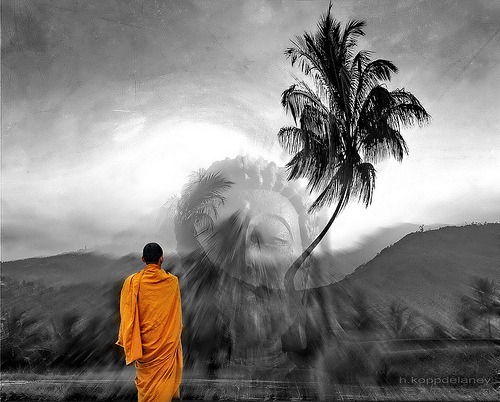
 The message of the Buddha is traditionally known as the Four Noble Truths. The last of these four truths sets out eight steps to happiness, which are: skillful understanding, skillful thinking, skillful speech, skillful action, skillful livelihood, skillful effort, skillful mindfulness, and skillful concentration.
Although skillful mindfulness is one of the eight steps, it also underlies each of the other steps. In other words, bringing mindful awareness to every aspect of your daily life is a key component of happiness.
Below you’ll find tips and techniques offered by three different Buddhist monks to help you lead a more mindful, and ultimately a happier, life.
Matthieu Ricard: Well-Being Is a Deep Sense of Serenity and Fulfillment
Buddhist monk Matthieu Ricard was born in Paris. The son of a renowned French philosopher, he grew up surrounded by the great thinkers and personalities of the time. Ricard is the author of the book “Happiness: A Guide to Developing Life’s Most Important Skill”. He has devoted his life to trying to answer these two questions:
- “What is happiness?”, and
- “How can we all get some?”
Ricard’s conclusion is that we can train our minds in habits of happiness.
In his TED.com talk, Ricard explains that instead of trying to define “happiness”, we should call it well-being. In addition, well-being is not just a mere pleasurable sensation; it’s a deep sense of serenity and fulfillment. It’s a state that pervades and underlies all other emotional states–all the joys and sorrows that come one’s way. Well-being is a state of being; it’s not just a fleeting emotion.
Ricard adds that very often in our quest for happiness we look outside. We think that if we could gather this and that, then we would be happy. However, our control over the outer world is limited, temporary, and often illusory. So, what if one of the things that we think we need in order to be happy is missing? Then it all collapses.
If we look inside, instead of looking outside of ourselves, we realize that it’s the mind that translates the outer conditions into happiness or suffering. Look at the two following types of people:
- There are people who are always complaining and who always focus on the negative aspects of a situation.
- There are people who even under very difficult outer circumstances manage to keep their inner serenity, inner strength and inner freedom.
According to Ricard, it all comes down to training the mind, and the best way to train the mind is through meditation.
Henepola Gunaratana: Our Happiness Is a Result of Our Actions
Henepola Gunaratana–a Sri Lankan Buddhist monk–explains in his book “Eight Mindful Steps to Happiness”
The Buddha understood that if we looked carefully at our lives we would realize that the choices we make lead to either happiness or unhappiness. And once we understand this principle thoroughly, we will be able to make good choices, because we want to be happy.
Gunaratana adds the following: “The basis of Buddhist morality is that acting in unskillful ways leads to unhappy results, and acting in skillful ways leads to happy results. This simple principle of cause and effect is an aspect of what Buddhists call kamma (or karma).”
Once we understand that everything we think, say, or do is a cause, which will inevitably lead to some effect, we will naturally want to think, say, and do things which will lead to positive results. At the same time, we will avoid having thoughts, saying things, and doing things that will lead to negative results. Taking this approach will allow us to focus our attention on making choices that will lead to a happier life.
The Buddha pointed to ten actions which are always unskillful because they inevitably lead to suffering for both the doer and the recipient. These ten actions are the following:
- Killing
- Stealing
- Sexual misconduct
- Lying
- Malicious words
- Harsh language
- Useless talk
- Covetousness
- Ill will
- Wrong view of the nature of reality
In addition, any action that comes from a mind that is filled with greed, hatred, or delusion leads to suffering and is therefore unskillful or wrong.
In order to act wrongfully, you have to be lying to yourself about cause and effect. That is, you’re acting against the basic truth that actions have consequences. If you train yourself to be mindful of what you do, and ask yourself whether what you’re about to do is likely to lead to positive or negative results, you’ll be heading in the right direction. You’ll be heading toward happiness.
Thich Nhat Hanh: Happiness is Being at Peace In the Present Moment
Vietnamese Thich Nhat Hanh is the first Buddhist monk I ever read and he still remains my favorite (yes, I have a favorite Buddhist monk). In his book, “Peace Is Every Step: The Path of Mindfulness in Everyday Life”
In his book Thich Nhat Hanh offers a variety of simple, very accessible techniques in order to help us remember that happiness is all around us. One of the things he recommends is that you hang up a reminder in your room so that the first thing you do as soon as you wake up each morning is smile. This reminder can be anything:
- A painting;
- A flower;
- A leaf;
- An inspiring quote, and so on.
Smiling will help you to approach the day with gentleness and understanding. Thich Nhat Hanh adds that a friend once wrote the following short poem:
“I have lost my smile,
but don’t worry,
the dandelion has it.”
The message in the poem is that even if you’ve momentarily lost your smile, as long as you realize that a dandelion is keeping it for you, the situation is not so bad. That is, even if something has gone wrong in your life, there’s always something positive that you can choose to focus on.
Of course, there’s also Thich Nhat Hanh’s famous breathing exercise. It goes as follows:
- Breath in while reciting: “Breathing in, I calm my body.”
- Then, breathe out while saying, “Breathing out, I smile.”
- Do this three times.
And that’s it: the secret to peace and happiness is breathing and smiling. After all, both peace and happiness already reside inside of you. You just have to stop getting in the way and allow them to rise to the surface.
Conclusion
In order to be happy, look for happiness within, instead of seeking it outside of yourself; analyze the consequences of your thoughts, words, and actions; and focus on the happiness and abundance that is all around you. Follow the Buddhist path to happiness, and live your best life.















Related Posts:
1. 23 Wise Ways to Increase Your Happiness
2. How to Calculate Your Net Happiness
3. Harvard’s Most Popular Course: Tal Ben-Shahar On How to Be Happier
4. 37 Tidbits of Higher Consciousness
Did you enjoy this article? Subscribe to “Daring to Live Fully” by RSS or by email, and get free updates.
 Marelisa Fabrega is a lawyer and entrepreneur. She holds a Bachelor of Science in Business Administration from Georgetown University in Washington, D.C., as well as a Juris Doctor from the Georgetown University Law Center. You can learn more about her


Comments on this entry are closed.
Thanks Marelisa,
I’ll look at my lawn very differently tomorrow when I see the dandelions 🙂
Please change email to the above. It is new.
Thanks Helene
Hi Richard, Then the post has served its purpose. 🙂
I am new to your site Marelisa and just stumbled upon this article. It is so beautiful. Just reading it helped me to connect in this moment and feel so peaceful.
“I have lost my smile,
but don’t worry,
the dandelion has it.”
I have never heard this quote before but it made me a little tearful (in a good way!).
Thank you so much for writing this blog – I will be sure to come back for more. Please let me know if there is anything I can do to help your blogging (I’m still new to this whole blogging scene) but am so happy to connect with people who are shining a great light.
With love,
Jess
This post touched me. I know well being is, as the daoists say, the way. Lately, I’ve been feeling that I need to return to the path that has always been there.
Thank you.