
 Seth Godin explains in his blog post “Opening Acts and Rock Stars” that rock stars have it good: the crowd chants for them before they’re even on stage, people know their songs and sing along excitedly throughout the concert, and they can even stop singing and the crowd will finish the lyrics for them. But what happens when you’re not a rock star, in fact, you’re not even the opening act? You create anyway.
Below you’ll find seven examples of people who continued to create even when they were basically toiling in the dark.
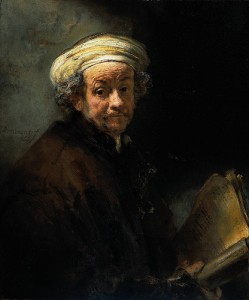
Rembrandt van Rijn – Don’t Allow Outside Circumstances to Stop You From Creating
In the 17th century the Netherlands was the most prosperous country in Europe. Rembrandt van Rijn–one of the most sought after Dutch masters–was born in 1606 and won acclaim from an early age. His ability to capture the essence of his subjects’ characters made him popular.
He was doing extraordinarily well with his paintings–and was making lots of money and living an extravagant lifestyle–when the Dutch art market collapsed. Rembrandt had mortgaged himself to the hilt and all of a sudden he had creditors banging on the door while his clients disappeared.
In 1658 Rembrandt was forced into bankruptcy. The courts sold his house and possessions. Living in near-poverty without a glimmer of hope that the Dutch economy would improve, he nonetheless kept right on painting. Some even argue that he produced his best work during this time. (Source.)
Emily Dickinson – The Recluse
Born in 1830, Emily Dickinson spent almost all of her life in the same house and yard in Amherst, Massachusetts. Although she was always shy and withdrawn, for the last 25 years of her life she was a recluse, hardly ever leaving her home and grounds in Amherst.
Emily was an eccentric and an extreme individualist; she had several minor peculiarities, such as always wearing white and avoiding visitors. Her two great passions were her garden and her poetry, both of which she cultivated for her own pleasure and not for public display.
She scribbled her poems on the backs of envelopes and odd scraps of paper and stored them in bundles in her room. Only five of her poems were published during her lifetime. After Emily’s death her sister, Lavinia, found the hoard of manuscripts and arranged for them to be published. Today Emily Dickinson is recognized as one of the world’s greatest poets.
The Brontë Sisters – Charlotte, Emily, and Anne
The Brontë sisters were brought up by an eccentric father in the desolate and gloomy Yorkshire moors. From an early age they were responsible for their own entertainment. They read voraciously and took long walks along the moors.
In 1845 Charlotte discovered by accident that Emily had been writing poetry, even as she and Anne had been doing unknown to each other. The three sisters published their poems, each under a different pseudonym. Only two copies of their book of poetry was sold.
However, the lack of interest from the public in their poetry did not destroy their passion for writing, and each sister set about to write a novel. After numerous rejections by publishers, each published a novel in 1847:
- Jane Eyre by Charlotte
- Wuthering Heights by Emily
- Agnes Grey by Anne
Today, all three novels are considered important works of literature.
Vincent Van Gogh – Sold Only One Painting During His Lifetime
Vincent Van Gogh’s paintings and drawings are some of the most recognizable art that exists today. However, it is well-known that the Dutch Impressionist painter met with little success during his lifetime. He was basically supported by his brother, Theo, and he sold only one painting while alive: “Red Vineyard”, which was sold in Brussels for 400 francs (roughly $350.00 at today’s rate).
As an example of what Van Gogh’s paintings are worth today, his painting “Portrait of Dr. Gachet” was auctioned off at Christie’s, New York, in 1990 and went for 82.5 million dollars. It’s one of the world’s most expensive paintings.
Johann Sebastian Bach – As a Composer He Was Unappreciated During His Lifetime
Johann Sebastian Bach was a German composer and organist born in 1685. Today he’s widely considered to be one of the greatest composers in the Western tradition.
However, although he was a famous organist in his lifetime, he was not particularly well known as a composer. In fact, his adherence to Baroque forms and contrapuntal style was considered “old-fashioned” by his contemporaries, and it was not until the early 19th century that there was a revival of interest and performances of his music.
For someone whose composing abilities were not truly appreciated during his lifetime, the following comment by scientist and author Lewis Thomas illustrates how much his music is venerated today. Thomas once suggested how the people of Earth should communicate with the universe:
“I would vote for Bach, all of Bach, streamed out into space, over and over again. We would be bragging, of course, but it is surely excusable to put the best possible face on at the beginning of such an acquaintance. We can tell the harder truths later.” (Source).
The Sex & Cash Theory
Hugh Macleod of gapingvoid.com fame offers a solution for those who are creating in the dark but are not too keen on starving for their art; he calls it “the sex & cash theory”. He argues that the creative person has two kinds of jobs:
- The sexy, creative type; and
- The one that pays the bills.
Maybe you wait tables while going on auditions; or you play at weddings and bar mitzvahs while putting together a fantastic demo tape; or you work at a portrait studio and then take a month off each year and go photograph wild life in Alaska; or you teach English at the local high school while writing your novel.
Hugh adds that in the book “Soul Dance”, Bill Plotkin argues that there’s a Survival Dance and there’s a Sacred Dance. The survival dance has to come first, because it provides the means of supporting yourself physically and economically. For most people, this means a paid job.
Once you’ve established a strong foundation for yourself through your survival dance, then you can start looking for clues as to what your sacred dance is : the work you were born to do. Here’s how you know when you’ve found it:
“You know you’ve found it when there’s little else you’d rather be doing. Getting paid for it is superfluous. You would gladly pay others, if necessary, for the opportunity.”
That is, it’s the work you continue to get up and perform every day even if you lose everything you’ve worked for–like Rembrandt did–; or if your work gets called old fashioned, or worse, by your contemporaries as in Bach’s case; or if you can’t find a publisher like the Brontë sisters; or if you write your poems on the backs of envelopes like Emily Dickinson did.
Conclusion
Plotkin indicates in “Soul Dance” that once you discover your sacred dance and learn effective ways of performing it, the world will support you in doing so. Then, gradually, your sacred dance will become what you do and you will no longer need your survival dance.
However, even if your work goes completely unappreciated by others–as in the case of Vincent Van Gogh’s paintings during his lifetime–continue to do your sacred dance, even if it’s just in your spare time and you are your only audience. No matter what, create.

Related Posts:
1. The Night Before Christmas and Stealing Like An Artist
2.Creativity Tools: 24 Free Online Creative Thinking Tools
3.57 Tips For Writers, From Writers
4. Stuck for An Idea? Try SCAMPER
5. Need Fresh Ideas? Go Streetcombing
I Recommend:
1. How to Live Your Best Life – The Essential Guide for Creating and Achieving Your Life List
2. Make It Happen! A Workbook for Overcoming Procrastination and Getting the Right Things Done
3. How to Be More Creative – A Handbook for Alchemists
4. The One-Hour-A-Day Formula: How to Achieve Your Life Goals in Just One Hour a Day
Did you enjoy this article? Subscribe to “Daring to Live Fully” by clicking here and get free updates.
 Marelisa Fabrega is a lawyer and entrepreneur. She holds a Bachelor of Science in Business Administration from Georgetown University in Washington, D.C., as well as a Juris Doctor from the Georgetown University Law Center. You can learn more about her


Comments on this entry are closed.
Loved reading about these other people! I truly believe it is our God given duty to find our sacred Dance….and it just may surprise you!
I love all of your work, Marelisa, but this blog entry speaks to me. Thank you so much for putting this material out there for us. You’re the best.
I hesitate to add this observation because it is a bit of a downer, but….it is something I have observed to be true. I call it “the real job.” I have seen men and women become accomplished artists or stand up successful small businesses. In almost every case, somebody had a real job that allowed their mate to pursue their dreams. By a real job I mean a full time job with reasonable pay and benefits, especially health insurance. Somebody has to pay the bills. Somebody has to keep the business running when the cash flow isn’t there.
From my observations, small business men and women work 60-80 hours a week. They have no spare time. It has been said that 10,000 hours are required for mastery in any art. That would be five years of focused full time effort, traditionally under the tutelage of an accomplished master. In my area, almost nobody works a 40 hour week. Then there is the commute, two hours a day is not unusual. Again the partner with the real job is pushing towards 60 hours a week. Sometimes 50-60 hours a week is spent in a poorly fitting job that just sucks the energy out of the partner who is laying down their life for the family. After taking care of paying the bills and kissing the children goodnight, what do they have left to pursue mastery?
Your article sites a number of examples that fit the model. Vincent Van Gogh, The Brontë sisters, and Emily Dickinson all had somebody with a real job paying the bills.
Still as the song says, “Let that boy boogie woogie. It’s in him and it has to come out.” I will continue to write whether anyone ever pays me or even reads what I have to say because it is in me and it has to come out.
By the way your blog gives me hope.
Marelisa, as an author and artist, this resonates with me. I have five jobs, 4 of which I love and one which pays the bills. The four jobs are all creative and are my true calling. But ‘true along’ doesn’t pay the bills.
Thank you your great insight.
Debi