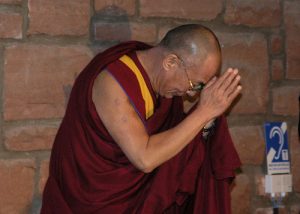
“I believe that the very purpose of our life is to seek happiness.” — The Dalai Lama
Tenzin Gyatso, His Holiness the Fourteenth Dalai Lama, is the spiritual and temporal leader of the Tibetan people. The book “The Art of Happiness – A Handbook for Life” was written by psychiatrist Howard C. Cutler based on a series of interviews held with the Dalai Lama during the Dalai Lama’s visit to Arizona and in his home in India, augmented by some of the Dalai Lama’s public talks. As is illustrated by the quote above, the Dalai Lama believes that the very purpose of our existence is to seek happiness. Here are three of the ways recommended by the Dalai Lama to cultivate happiness:
Happiness Can Be Achieved Through Training the Mind
The Dalai Lama’s approach to happiness relies heavily on learning, reasoning and training the mind. He explains that through inner discipline we can undergo a transformation of our attitude, our outlook and our approach to living.
In Buddhism causality is accepted as natural law. Therefore, if there are certain types of events that you do not desire, then the best way of safeguarding against those events taking place is to make sure that the causal conditions that normally give rise to those events don’t arise. Similarly, if there’s an event that you would like to take place, then you should seek the causes and conditions that give rise to that event.
This same principle of causality can be applied to your mental states. If you desire happiness, you should identify those factors which lead to happiness and those factors which lead to suffering. Having done this, you can gradually eliminate those factors which lead to suffering from your life and cultivate those which lead to happiness. That is, one achieves happiness through learning which mental states to cultivate and which to eliminate, and then making a sustained effort to implement this knowledge.
The Dalai Lama explains that education—focused specifically on understanding and implementing the factors that lead to lasting happiness–is crucial because the more sophisticated your knowledge is about what truly leads to happiness and what doesn’t, the more effective you will be in achieving happiness. In addition, deliberately selecting and focusing on positive mental states which lead to happiness—such as love, compassion, patience, and generosity– and challenging negative mental states which lead to suffering—such as hatred, greed, and envy—requires a systematic training of the mind.
As Cutler explains in “The Art of Happiness”, the most distinguishing feature of the Dalai Lama´s method of training the mind involves the idea that positive states of mind can act as direct antidotes to negative states of mind.
Working on our mental outlook is a more effective means of achieving happiness than seeking it through external sources, such as wealth or position. There are countless examples of people whose level of happiness rose significantly immediately after winning the lottery or experiencing some other financial windfall. However, these examples show that after the initial elation the positive feelings taper off and the person goes right back to the same level of happiness they experienced before the sudden rise in wealth. This is evidence that happiness is determined more by one’s state of mind than by external events.
The approach of focusing on your mental outlook also places the secret to happiness within your own hands, instead of leaving it at the mercy of external factors, most of which are not within your control.
The Dalai Lama summarizes his point as follows: “As long as there is a lack of the inner discipline that brings calmness of mind, no matter what external facilities or conditions you have, they will never give you the feeling of joy and happiness that you are seeking. On the other hand, if you possess this inner quality, a calmness of mind, a degree of stability within, then even if you lack various external facilities that you would normally consider necessary for happiness, it is still possible to live a happy and joyful life.”
Happiness Can Be Achieved By Shifting Perspective
The Dalai Lama goes on to explain that the ability to shift perspective is one of the most powerful and effective tools we have to help us cope with life’s problems. He adds that when problems arise our outlook often becomes very narrow: we focus all of our attention on worrying about the problem and we often feel that we’re the only ones facing this difficulty. When this happens, shifting perspective—whether by looking for opportunities which could arise from the situation, taking a wider perspective, or thinking of how things could be worse—can make the problem seem smaller and more manageable.
Difficult situations are often opportunities for growth. Cutler—the psychiatrist interviewing the Dalai Lama–interjects that he worked at a facility in which he had a number of run-ins with the facility’s administrator. They were constantly arguing over the fact that Cutler felt that the administrator was compromising patient care in favor of financial considerations. These run-ins were instrumental in Cutler’s decision to quit working at that facility. Although at first this appeared to be a negative situation, it ultimately led to Cutler finding more satisfying work.
The Dalai Lama uses the approach of taking a wider perspective when dealing with the situation in Tibet. He explains that if he looked at the situation in Tibet from a narrow perspective, and focused only on that, then the situation looks almost hopeless. However, if he looks at it from a wider worldwide perspective, then he sees an international situation in which communist and totalitarian regimes are collapsing and even in China there’s a move toward democracy. So he doesn’t give up.
In addition, researchers have conducted a number of experiments demonstrating that one’s level of life satisfaction can be enhanced simply by shifting one’s perspective and contemplating how things could be worse. How we feel at any given moment has little to do with the conditions themselves, but is rather a function of how we perceive the situation and how satisfied we are with what we have.
When a situation is causing negative emotions spend some time seriously searching for a different perspective on the situation. A key component to happiness is adopting a flexible, malleable approach to life.
Compassion and Altruism Lead to Happiness
Compassion, the Dalai Lama explains, is a mental attitude based on the rationale that all human beings have an innate desire to be happy and to overcome suffering, coupled with a desire for others to achieve this. It’s associated with a sense of commitment, responsibility, and respect toward the other. In fact, in developing compassion one should begin with the wish that oneself be happy and free of suffering, and then take that natural feeling toward oneself and extend it out to include and embrace others.
In generating compassion the Dalai Lama suggests that you think of someone who is actually suffering and allow your natural response to arise: a natural feeling of compassion toward that person. Now think of how strongly you wish for that person to be free from that suffering, and resolve that you will help that person to be relieved from their suffering.
The altruism that arises from compassion is a key component of happiness. Several studies have shown that helping others can induce a calmer mind and a feeling of happiness. In a survey by Allan Luks conducted with several thousand people who were regularly involved in volunteer activities that helped others, over 90 percent of those volunteers reported a kind of “high” associated with the activity, characterized by a feeling of warmth, more energy, and a kind of euphoria. Following the volunteer activity they also had a distinct feeling of calmness and enhanced self-worth.
Conclusion
Despite all the loss he has experienced, nearly every time you see the Dalai Lama he’s either laughing or smiling. If you ask him whether he’s happy he answers “Yes” without hesitation. He emphasizes that happiness is built on the foundation of a calm, stable mind. The tips explained above are three of the ways he recommends to achieve ultimate happiness.

Did you enjoy this article? Subscribe for free by RSS or e-mail and you’ll always know when I publish something new. (What’s RSS?). Also, please share it on the social media site of your choice.
photo credit: mrpattersonsir
Related Posts:
- Five Joyous Tips for Being Happy
- 12 Superb Ways to Be Happier
- Be Happy Now – Set Goals Without Postponing Joy
- Thich Nhat Hanh and The Art of Mindful Living
- More Happiness Tips: Eckhart Tolle
I Recommend:
My ebook “How to Be More Creative – A Handbook for Alchemists” explains that creativity is not the sole domain of the arts but is important in any field. Whatever you do, creativity helps you do it better. Discover practical advice on how to be more creative in every life endeavor by reading my ebook.
The Sedona Method is a simple, powerful, easy-to-learn technique that shows you how to let go of any negative, unwanted or painful feelings you may be experiencing at any particular moment. It consists of a series of questions you ask yourself that lead your awareness to focus on what you’re feeling in the moment and gently guide you toward letting it go. Read my review of the Sedona Method here.


{ 50 comments… read them below or add one }
“There is no way to happiness. Happiness is the way.” ~Wayne Dyer
C.B.Joness last blog post..Some people cut themselves, others level up.
Hi C.B.: Beautiful Wayne Dyer quote, thank you for adding it.
I agree – we are always looking for happiness behind every little corner of our world- if we stop and look in the mirror, and smile, we would realize happiness has been right here the whole time! Thanks Mare!
Jays last blog post..Inner Noodle’s Guide to Dream Analysis-Step 4
Mare,
I’m a big fan of the Dalai Lama, and am working on that calm, stable mind he recommends! Your paragraph said it most clearly for me: “In Buddhism causality is accepted as natural law…” This is such a practical, wise approach to life. I like this article a lot!
Daphnes last blog post..How To Write A Personal Creed
I’m definitely a fan of happiness! I follow the Dalai Lama on Twitter (and he follows me right back!), and I appreciate his wisdom. Many years ago I started doing some of these things although I’m not sure what prompted me – I began identifying sources of joy and misery and then seeking them out (or avoiding them) to increase my own happiness. I can say that it works wonders!
Melissa Donovans last blog post..Word Pairs: That and Which
Interesting that we posted about shifting perspectives and some of the recommendations from the Buddhist perspective at roughly the same time. I definitely like the concrete ideas of shifting it through looking for opportunities which could arise from the situation, taking a wider perspective, or thinking of how things could be worse. We feel stuck whenever we are too focused on our own set of problems, that we fail to see things at a bigger level. Opportunities fly by and we won’t even know it. Doing some charity work to those who are less unfortunate can help us gain a better perspective of life. Compassion builds! Our state of mind becomes positive and voila….what is originally perceived as a difficulty is no longer so!!
Evelyn Lims last blog post..Making Sense Of Life Events
Wonderful post! I particularly liked the insights about shifting perspective and compassion.
Catherine Cantieri, Sorteds last blog post..When was the last time you backed up your data?
Dalai Lama is one wise man. I’ve actually been working on training my mind for the past five years. The best part is I sleep better. I’m not as worried as I once was of the unknown.
I need a lot more practice, but I can feel that I’m on the right path.
What I learned from this is still to become even more compassionate – toward myself and others. I can be a big bully to myself. I need to let go of some of my expectations and embrace who I am. One day at a time.
Karl Staib – Work Happy Nows last blog post..Your Company Should Do Annual Career Counseling
I have read this book several times and just gave my copy away to a very good friend who is grieving….It is just one of my favorites.
You do such a lovely job of detailing this book and your clarity is so edifying, Thank you for this post.
You just always do such a wonderful job and I appreciate your writing.
Patricias last blog post..“My Neighborhood Looks Like a Snow Globe!”
Hello,
In my opinion possibly what is missing here in this lovely post of yours is that the Dali Lama also teaches that we need to own our suffering in order to recognise our happiness.
Happiness doesn’t exist without that understanding. Happiness is transient …. I think that the ultimate goal may be resillience.
Best wishes Ribbon
Ribbons last blog post..Fart…
This is so much better than the typical Western attitude of “once I buy a plasma TV, I’ll be happy” or “when I get that promotion, I’ll be happy.”
Mare,
Love it and love the man. I saw him in Chicago years ago. I learned to begin shifting my perception when my daughters were teenagers! I continue to do it today with world problems and any relationship issues that come up. It’s the only way to live…happy!
Tess The Bold Lifes last blog post..Magic Mondays Are 1/7 of Your Life!
Lovely! I love this article. It came at the right time!!
Elaine B.s last blog post..Letterpress Wannabes Le Pouf French Antique Note card set of 3 Bridesmaid gift
I appreciate the focus on having happiness and joy without needing the external “stuff” that humans typically consider necessary for happiness.
Stacey / Create a Balances last blog post..Letting Go of What I Have Planned
This truly works because I’m living testament of that. Change your mentality and perspective and you can be quite happy. I used to be quite different – I’d get shots of happiness from external events and then crash. Now I’m pretty happy like 99% of the time. The external events still give me a high, I can’t deny that, but I don’t crash anymore
.
Marita
Marita Greenidges last blog post..Get Your Ego Out of the Way and Listen to Your Critics!
Thanks for the uplifting post.
Hi Katie: I`m glad you enjoyed it
Hi Marita: I`ve experienced something similar in my life. In fact, I think it started when I started reading personal development books in college, so I agree with the Dalai lama that learning and knowledge are important components of happiness.
Hi Elaine: Thank you and I`m glad
Hi Tess: I`ve read that he`s incredibly charismatic and that people walk for two years to visit him in exile in India. It’s amazing how a situation can remain the same and yet by changing your perspective you can completely change how you feel about the situation.
Hi Vered: Maybe Buddhist monks should teach a course at Western schools so that people learn to appreciate what is truly important from an early age.
Hi Ribbon: Interestingly enough I was watching on CNN today that it`s the anniversary of the uprising in Tibet. The Dalai Lama referred to Tibet as “hell on earth”, and yet he continues with his message of seeking political autonomy for Tibet. I think that if he lost hope and just focused on the suffering that is going on in Tibet he would lose his ability to effectively carry forth his message to the rest of the world. I think it is about resilience, but at the same time it’s about cultivating the inner peace that allows you to feel emotions such as patience, compassion and hope even when there is so much suffering go on.
Hi Patricia: Thank you
I`ve owned this book for awhile and had started reading it in the past but it wasn’t until this weekend that I sat down and really read it. I thought it was a beautiful book and wanted to share what I learned from it on my blog. I`m glad you liked the post.
Hi Karl: The Dalai Lama explains in the book that it takes a long time to train the mind. He started at the age of four. As long we`ve gotten started on that path I think we`ll be fine
Hi Catherine: I like the technique of feeling compassion for ourselves and then extending that feeling toward others.
Hi Evelyn: I thought it was interesting too. Do you know what’s also interesting? Like I wrote to Ribbon above, today is the anniversary of the uprising in Tibet. And I completely agree that compassion builds.
Hi Melissa: I follow the Dalai Lama on twitter too
And I was very impressed when I got an email saying he was following me back. Well, I guess you instinctively knew what to do. And now it’s being reenforced by the Dalai Lama.
Hi Daphne: Thank you. When I read the part about causality I thought: this makes a lot of sense. Decide how you want to feel, identify what makes you feel that way, and set things up so that the things that make you feel happy take place.
Hi Jay: I think people sometimes don`t want to take responsibility for their own happiness, so they identify the source of happiness as something outside of themselves. It takes a lot of work to train the mind to the point that you can remain calm regardless of what else may be happening around you, but it`s definitely worth it.
He is a very wise man indeed. If we all could be a tiny bit like him, the world would be a better place.
Mindful Mimis last blog post..There is no delight in owning anything unshared — Seneca
Hi Mare,
I am so much happier than I used to be – and the only thing that has changed is my perspective. I have a long way to go but I have learned to be calm, detached and connected at the same time. My dad was perhaps my biggest teacher. Great article!
Mayas last blog post..The One Hundred: A Guide to Pieces Every Happy and Balanced Soul Must Embrace: Simplicity
Hello again
you’re right it’s about everything as nothing exists without the other.
best wishes Ribbon
Ribbons last blog post..Fart…
I’ve read most of “The Art of Happiness.” I gotta finish it.
You write:
“In fact, in developing compassion one should begin with the wish that oneself be happy and free of suffering, and then take that natural feeling toward oneself and extend it out to include and embrace others.”
I actually have given thought to why people do such self destructive things to themselves. In fact, we all do to varying degrees. Whether it tormenting ourselves over something, or even physically harming ourselves…. Whatever the case…
I think it is quite possible that a big factor in these behaviors is a lack of self-love for ourselves. It’s not obvious to us, however. But if we really take the time to think about it, I think we sometimes do not love ourselves the way we should. And by loving ourselves we will treat ourselves better. We will treat others better too, so they say.
Mare,
Excellent post. I have read most of it and will finish it later today.
I think that calmness of mind is where happiness lies. A peaceful mind is a balanced mind which can’t be agitated by outside events. Achieving balance brings us back to our natural state, which is happiness.
Thanks for sharing your insight.
Ryan
Hi Bamboo: I agree with your analysis. A lot of people are hurting themselves, whether it’s by smoking, being overly critical of themselves, sabotaging their own success, and so on. We do need to begin by being kind to ourselves and then we’ll be in a better position to be kind toward others.
Hi Maya: It´s amazing how we can completely change our mental state simply by looking at a situation from a different angle. The situation stays the same, so the change in how we feel comes solely from the story we chose to tell ourselves about what is happening.
Hi Mimi: And he has such an enormously heavy load to carry. You´re absolutely right that the world would be a much better place if we could all be just a little bit more like him.
The message and philosophy is so simple and makes sense. I wonder why more people don’t follow his teachings?
Jannie Funsters last blog post..Song Quest Two
Hi Jannie: His teachings aren’t in line with the typical Western mindset: happiness comes from having the biggest house, the nicest car, and the best job title. Of course, happiness doesn’t really come from these things, which is why there’s so many unhappy people.
Hi Marelisa, It wasn’t all instinct. I did some reading, watched documentaries, and started paying attention to people who I thought were leading happier, more fulfilled lives. These resources were indispensible – and I got on board with positive thinking (that’s essential).
Melissa Donovans last blog post..Plotting Fiction: The Elements of Plot
Mares, love this book and I agree completely with what the Dalai Lama says. Just wrote an epic comment, but something happened and I lost it. Cannot face writing it all again so I’ll just say I saw him in Sydney and he almost glows with a magical radiance. It’s not always easy in the face of overwhelming problems to look for the positive or the love or the opportunity, but if you can expand your consciousness, you will always be led to happiness and greater harmony in life.
Kelly@SHE-POWER
Hi Mare – I will have to read this awesome book. What you are saying makes so much sense.
Today I feel happier than I have felt for a long time. Now I guess I can achieve this feeling all the time by taking note of the things that have made me happy and also the things that were making me unhappy before . Then I just make sure I focus on attracting situations which make me happy and avoiding the latter right?
And once we learn how to do this, it will be far easier to help others do the same.
After I have read your new ebook, I’ll check out this book too.
By the way – I tried to email you a few days ago at your cableonda account. Have you changed email addresses or something?
Hi Cath: Just yesterday I was thinking about someone who has really been getting on my nerves lately and I started to get upset. Then I thought, thinking about this is basically the equivalent of having this person sitting next to me all the time, which is something that I definitely would not want to do. So I stopped thinking of the situation and started doing something more productive instead and immediately my feelings shifted.
Here’s me new email: marelisafabrega at gmail dot com
Hi Kelly: I’m sorry you lost your original comment. You´re very fortunate to have seen the Dalai Lama in person, I´ve never had that opportunity. And I completely agree that it’s not easy to look for the positive where overwhelming problems are concerned, but if you manage to train your mind to the point where you can do this you can basically create happiness at will.
Hi Melissa: It’s always a good idea to see what happy are doing and then copy them
I love the quote at the start of your article, Mare – I quite agree!
Robins last blog post..Making The Most Of Life
Hi Robin: I love that quote too. There’s a lot of good quotes by the Dalai Lama in the book.
I saw this book on the shelves the other day, and almost bought it. I’m a huge fan of the Dalai Lama, and I am on a quest to be happier, so it seemed like a great idea. For some reason, it just didn’t “feel” right at the time. But now that you’ve written this, I think I might go give it a second look!
Jay Schryers last blog post..So I Quit My Job Today
Hi Jay, I loved the idea that happiness is something that is achieved through learning and through reason. Regardless of what might be happening around you, you can train your mind to remain calm and at peace. If you are looking for happiness books I would recommend Stumbling on Happiness by Daniel Gilbert.
The Dalai Lama is amazing. Thanks for sharing this. Peace to us all in this coming year.