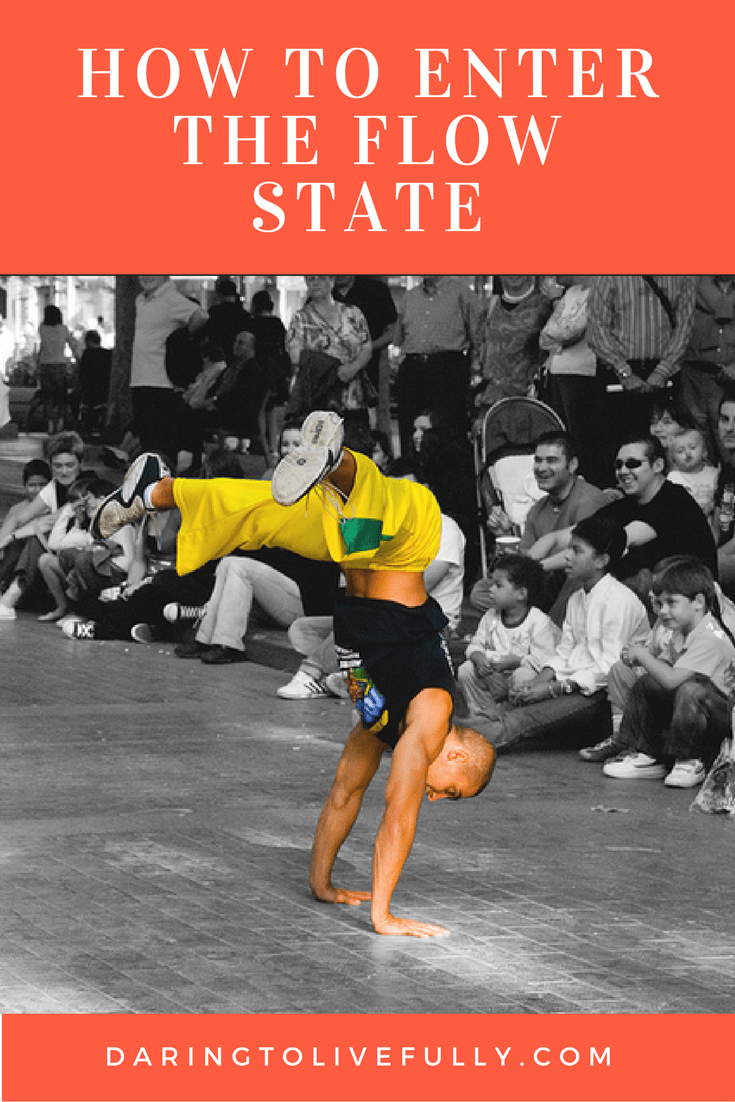
The state of flow, or being “in the zone”, is a state of peak performance.
“You are in an ecstatic state to such a point that you feel as though you almost don’t exist. I have experienced this time and again. My hand seems devoid of myself, and I have nothing to do with what is happening. I just sit there watching it in a state of awe and wonderment. And [the music] just flows out of itself.”
 The quote above is from a leading composer describing the state of flow. The flow state has been described by the world’s greatest thinkers as the most productive and creative state of mind in which to work. In addition, positive psychologists–most notably Dr. Mihaly Csikszentmihalyi, Ph.D.–argue that achieving the flow state on a regular basis is a key component of happiness. That is, by learning how to enter the state of flow you can increase your productivity, be more creative, and be happier, all at the same time.
This article will show you how to enter the state of flow.
What Is the State of Flow?
In 2004 Dr. Csikszentmihalyi gave a TED Talk in which he explains that the nervous system is incapable of processing more than 110 bits of information per second. If you’re listening to someone speak you need to process about 60 bits of information per second in order to understand what they’re saying. This is why if there are two people talking to you at the same time, you can’t listen to both of them and understand what both are saying.
He then goes on to explain that when you’re completely involved in the process of creating something new you don’t have enough attention left over to monitor how your body feels–the fact that you’re hungry or tired–or to listen to your mind chatter. People in the flow state, like the composer in the quote at the top of this blog post, explain that when they enter this state of ecstasy it’s as if they don’t exist.
Composing is an activity that requires intense concentration. The composer’s body and his identity disappear while he’s composing because he doesn’t have enough attention to be able to compose well and at the same time to feel that he exists. It’s as if his existence is temporarily suspended while he’s creating.
It’s also important to note that the composer has the ability to “switch off” so that the process of composing becomes almost automatic. He doesn’t have to consciously think of what he’s doing because he’s highly skilled and very experienced at composing. An important part of achieving the flow state is developing a high level of skill in the particular area in which you’re striving to achieve a flow state.
An accomplished figure skater describes “flow” as follows:
“It was just one of those programs that clicked. I mean, everything went right, everything felt good . . . It’s just such a rush, like you feel it could go on and on and on, like you don’t want it to stop because it’s going so well. It’s almost as though you don’t have to think, it’s like everything goes automatically without thinking . . . it’s like you’re on automatic pilot, so you don’t have any thoughts. You hear the music but you’re not aware that you’re hearing it, because it’s a part of it all.”
The Point at Which You Hit the State of Flow
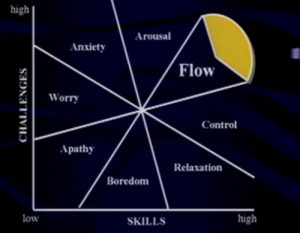 Dr. Csikszentmihalyi used the graph to the left during his TED.com talk to illustrate the point that in order to achieve a flow state, a balance must be struck between the challenge of the task and the skill of the performer. On the horizontal axis you measure how challenging the activity is, and on the vertical axis you measure your level of skill at that particular task.
As you can see from the diagram, there’s a point, let’s call it “the sweet spot”, where the level of challenge is high and the skills that you have to meet that challenge are also high, and it is at that point that you enter the flow state (the yellow area on the graph).
Notice how the interplay between how challenging an activity is and your skill level in that activity can make you feel as follows:
- Apathy (low challenge, low skills)
- Boredom (low challenge, mediocre skills)
- Relaxation (low challenge, high skills)
- That you’re in control (somewhat challenging, high skills)
- Worry (somewhat challenging, low skills)
- Anxiety (challenging, low skills)
- Arousal (very challenging, mediocre skills).
If you’re in the “arousal” state you can move into “flow” by developing more skills. On the other hand, if you’re in control you can enter “flow” by making the task more challenging.
How Does It Feel to Be in the Flow?
Thousands of people from every wake of like were interviewed by Dr. Csikszentmihalyi and his team in order to identify the key components of the flow state. These seven points summarize how those interviewed responded that they felt when in the flow state:
- You’re completely involved in what you’re doing: you’re completely focused and concentrated.
- There’s a sense of ecstasy–of being outside of everyday reality.
- There’s a great inner clarity: you know what needs to be done and you get immediate feedback on how well you’re doing.
- You know that the activity is doable, that you have the necessary skills to complete the task successfully.
- You lose your sense of self and all of your worries and concerns drift away.
- You lose track of time and you’re completely focused on the present moment.
- There’s an intrinsic motivation—whatever produces flow becomes it’s own reward.
Interestingly enough, the idea of flow came into being as result of research on happiness. Researchers began asking themselves: “What makes us happy?” and “When are we most happy”? As a result of this research psychologists realized that being able to enter the flow state–which is a very enjoyable experience–is a key component of happiness.
How to Achieve the Flow State
From everything stated above it can be seen that in order to achieve the flow state you need to do the following:
- Find a challenge. Choose something that you enjoy doing. It can be anything, whether it’s playing the piano, working on your novel, skiing, horseback riding, playing golf, and so on.
- Develop your skills in order to be able to meet the challenge. Remember that if something is too easy you’ll be bored–and your mind is likely to wander so you won’t achieve the flow state–, and if something is too hard you’ll be overwhelmed and you won’t be able to achieve that subconscious competence that is necessary for the flow state.
- Set clear goals. You want to be very clear on what you want to achieve and how you’ll know whether you’re succeeding. Here’s an example: “I’m going to write a blog post on how to achieve the flow state. I’ll know that I’m succeeding if I can clearly set forth what the flow state is, what it’s major components are, why it’s beneficial, and how to achieve it.”
- Focus completely on the task at hand. Eliminate all other distractions. You don’t want anything to take your attention away from the task that you’re performing; if your concentration is broken you’re going to exit the state of flow.
- Make sure that you’ve set aside sufficient time. It’s very likely that it’s going to take you at least fifteen minutes to start to get into the flow state, and a while longer after that until you’re fully immersed. Once you enter the flow state you want to make sure that you make the most of it, instead of having to stop prematurely because you have to go do something else.
- Monitor your emotional state. If you meet all of the requirements above, but you’re having trouble entering the flow state, monitor your emotional state. If you’re in an aroused state–angry, anxious, worried, and so on–, try doing something that will calm you down. Do you feel that your energy level is low and you’re feeling sluggish? Do something to pick up your energy levels, whether it’s doing jumping jacks, having a healthy snack, reading something motivational, or calling a friend who makes you laugh.
Conclusion
To conclude, here’s a quote from a poet on the flow state:
“It’s like opening a door that’s floating in the middle of nowhere and all you have to do is go and turn the handle and open it and let yourself sink into it. You can’t particularly force yourself through it. You just have to float. If there’s any gravitational pull, it’s from the outside world trying to keep you back from the door.”





Related Posts:
 Marelisa Fabrega is a lawyer and entrepreneur. She holds a Bachelor of Science in Business Administration from Georgetown University in Washington, D.C., as well as a Juris Doctor from the Georgetown University Law Center. You can learn more about her